Plate Reverb Build: Frame Construction

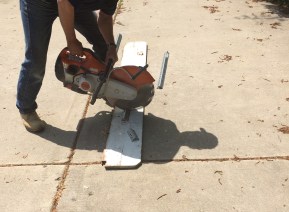
This week, I constructed the entire frame together for my plate reverb. From my needed materials post, you can see that I needed two pieces of 1 1/2″ x 60″ Zinc Plated Slotted Angle and six pieces of 1 1/2″ x 36″ Zinc Plated Slotted Angle to build the entire frame. After picking these up, they needed to be cut to the size that I designed in my blueprint.

However, after inspection of all my parts, I underestimated the length that my eye hooks and links would take up, so I extended my frame by one inch on all sides.

framebuild1 framebuild2

After cutting them to size, I needed to file down the edges that were just cut.

framebuild3

After getting these filed down the best that they could, I started by bolting down the corners through the slots that matched up to create my outside frame.

framebuild4

After getting this complete, I began to make the frame more rigid by adding four joints on the “outside” of the frame (the plate will go on the opposite end).

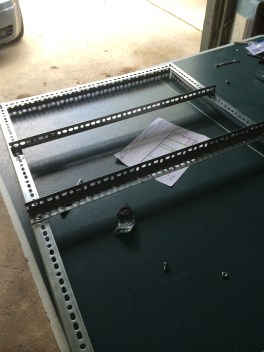
framebuild5 framebuild6

Here is the frame with the joint support:
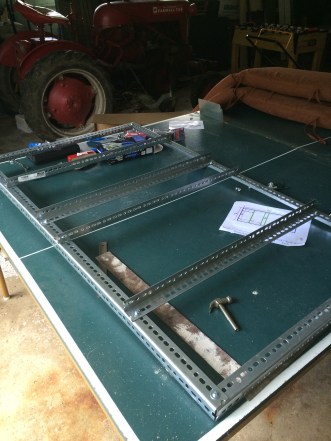
framebuld7

After putting everything together, we brought out a square to make sure that all the corners were exactly square. After doing this, we tightened everything down and added support for the corners to make them more stable.

framebuild8 framebuild9

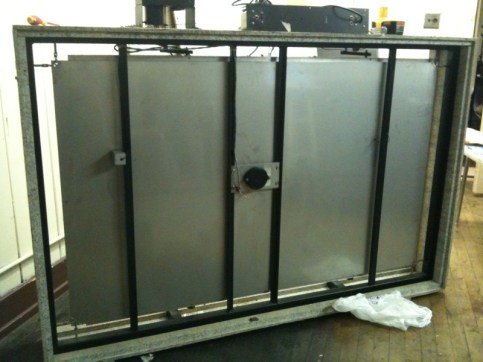
Here is the completed frame:

framebuild10

If the corner supports don’t work as well, I can always take them off and go back to the metal triangles to add rigidness to this frame. Next up, I will be installing the plate to this frame, which you should see done this coming week.

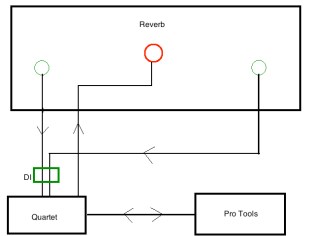
Plate Reverb Build: Researching Electronics, Part 2

On my last post: Researching the Electronics, Part 1. I talked about the piezo mics and what I would need to do to get them to have a balanced output. For this research, I will be talking about the transducer that I am using, as well as my input/output scenario.

ghost

For my transducer, I have decided on the Vidsonix Ghost Transducer. In my researching and looking at other DIY projects, including this Tape Op thread on them, I have found this to be what other people have started to use and are great for the money. I also have a couple of old speakers that I can dismantle and try out those voice coils to see how they sound, which will probably happen in future iterations of my plate reverbs.

My input/output will be all 1/4″ TS in and out. My recorded tracks will output from my Apogee Quartet into the 1/4″ TS input to the Vidsonix Ghost. Then, it will be picked up through my Piezo discs back through a 1/4 TS connector. I will have DI boxes to convert into a balanced mic level input, which will go back to the inputs of my Apogee Quartet’s pre-amps and into Pro Tools. I have decided on the 1/4″ TS because my piezo mics are unbalanced, so TRS connectors would be unnecessary.

Here is a diagram of that setup:

IO


Overall, I think this combination will be a good starting point for these reverbs and I can always upgrade my components at a later date.

Plate Reverb Build: Schedule

Now I am at a point in this project where all I have left to do is to build the reverb itself. I have done almost all the research, which I will be finishing up this week. I am treating week 9 as a flex week. If there are any difficulties that come up before that, there is a week where I can make it up.  I am still not sure if I will be making a damping plate and wooden frame for this reverb or if I will wait until later in the summer to do so.

Here is my whole build schedule for the rest of this project.

This week (6):

  • Build Steel Frame
  • Research Electronics, Part 2
  • Research Steel Acoustics

Week 7 (5/17-5/23):

  • Hang Plate By Frame
  • Build and wire all Electronics

Week 8 (5/24-5/30):

  • Mount Piezo Mics
  • Mount Transducer
  • Test Reverb to see if it works

Week 9 (5/31-6/6):

  • Analyze results of test
  • Damping Plate ???
  • Wooden Frame ???

Week 10 (6/7-6/13):

  • Tweak final product
  • Make samples to put on website
  • Take professional pictures

Plate Reverb Build: Damping Plate Research

With plate reverbs, a damping plate will effect the overall time of the reverb. The ones that EMT used could vary the reverb time from 2-5 seconds long. There are also several different ways to add one of these to a plate reverb. On the Ecoplate blueprints, they state that you should use Shasta ceiling tile (or any Owns Corning pinperf) cut into a lightweight steel frame. There are other reverbs that use regular fiberglass mounted to a plywood board, but according to Crossen Streams, who restored an ecoplate, doing that does not properly absorb the sound. I am guessing this is because it is fairly thin and the sound would go through it and come back without fully absorbing the sound.

Here are two pictures of the back of an old damping plate (Left) and a restored Ecoplate damping plate from Crossen Streams (Right):

fiber new

I have also seen DIY projects with fiberglass inside a wider frame and not mounted to anything. I am not sure on the effects of that and I might have to try it when it comes to the damping pate of my project.

A damping plate seems pretty simple to put on my reverb. The only thing I would have to figure out is how to make it adjustable so I can use it for my needs. I will probably figure something out after this project for my class is done. My overall plan would be to have a motor for it so it can be adjusted very easily. Idealy what the Pluto plate reverb does with an application controlling the damper is what I would want to do if I make these for commercial use.

Plate Reverb Build: Critiquing another D.I.Y Project, Part 2

For this critique, I will be looking at JCC & Associates’ Ecoplate Plate Reverb.

ecoplate

There are a lot of great things about this plate reverb. One of the ones that I liked the most was the fact that it is a close take on the legendary EMT140. One of the more intriguing parts of this is the fact that you can’t flat out buy one from their website or anywhere else. They only give you their schematics on their website, along with some of the parts that you can buy off of them.

And that comes to some of the things that I don’t like about it. There aren’t any instructions on how to put this one together. You are sort of on your own, though they have the most detailed schematics that I have found so far. Also, if you don’t know anything really about electronics and how to read and put together schematics, then you are at a major disadvantage on how to make their power amp and pre-amp.

This is what I eventually want to turn my reverb into after a few prototype versions, which will scale up to the quality that the Ecoplate brings to the table. I never heard of this plate reverb before this project, so I’m not really sure on the overall draw of this particular reverb, though people seem to really like this one as well.

Pros:

  • Similar to the iconic EMT 140
  • Very detailed blueprint
  • Can buy the same voice coil and mics they use from them

Cons:

  • No actual pictures of unit on website
  • No directions on how to build them