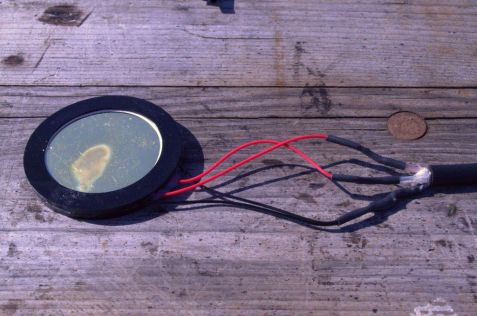
Plate Reverb Build: The Result!

Earlier this week I completely finished my plate reverb. The final things that I needed to do after hanging my plate was hooking up all the electronics and testing to make sure they worked. I started off by drilling some holes in the middle of the plate to bolt my transducer directly to the plate. Here are a couple pictures of that process. I ended up using rubber washers for the backside so I could isolate the metal on metal contact as much as possible.
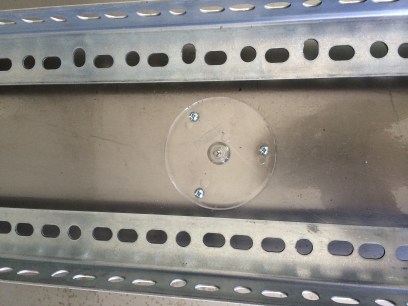
plate1 plate2
plate3

After hooking that up, I had to wire my transducers to some speaker wire. I ended up soldering them together to get a firm connection.

plate4 plate5

After hooking these up, I connected my speaker wire to the 1/4″ mono input jacks, so I could get a signal from the piezo mics. I made sure that I was connecting the right wire to the positive terminal of the 1/4″ jack.

fvdnjfs

After completing all of these tasks, I was done with wiring all my electronics and tested everything to make sure that it worked. To power my transducer, I tried using the headphone amp from my Apogee Quartet to see if it would work. I did get a signal, though it wasn’t as powerful as I wanted it. I made the mistake of not double checking the power requirements of my transducer, and when I hooked up a bigger amp that I thought would work, it ended up blowing the whole thing.

That means that I did not get all the tests and samples that I wanted to get and had to order another transducer that will hopefully get here next week. I did however get one test done and below it shows a dry vocal, one with my plate reverb on it and one with the reverb that I had on in my mix.

That concludes everything that I wanted to get done with this project! I am pretty happy with how everything turned out and I know what I need to do to make a better version in the future. I will have a full analysis of this plate reverb in a couple of weeks when I get my transducer and I find a better amp to power it.
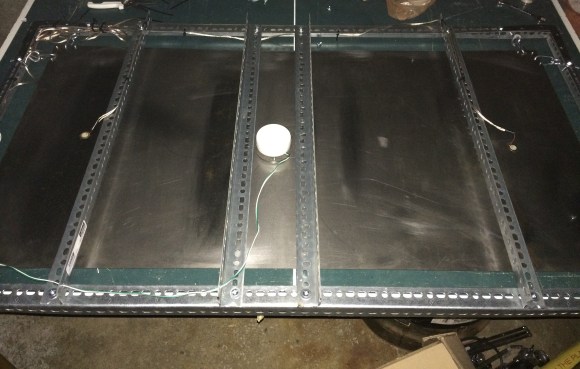
fdff

Plate Reverb Build: Researching Electronics, Part 2

On my last post: Researching the Electronics, Part 1. I talked about the piezo mics and what I would need to do to get them to have a balanced output. For this research, I will be talking about the transducer that I am using, as well as my input/output scenario.

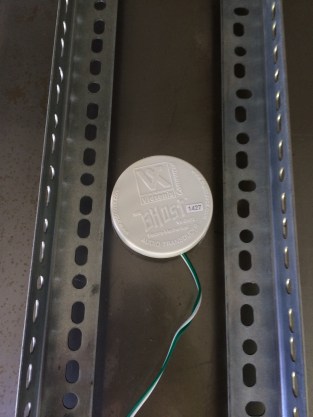
ghost

For my transducer, I have decided on the Vidsonix Ghost Transducer. In my researching and looking at other DIY projects, including this Tape Op thread on them, I have found this to be what other people have started to use and are great for the money. I also have a couple of old speakers that I can dismantle and try out those voice coils to see how they sound, which will probably happen in future iterations of my plate reverbs.

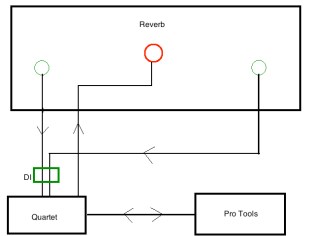
My input/output will be all 1/4″ TS in and out. My recorded tracks will output from my Apogee Quartet into the 1/4″ TS input to the Vidsonix Ghost. Then, it will be picked up through my Piezo discs back through a 1/4 TS connector. I will have DI boxes to convert into a balanced mic level input, which will go back to the inputs of my Apogee Quartet’s pre-amps and into Pro Tools. I have decided on the 1/4″ TS because my piezo mics are unbalanced, so TRS connectors would be unnecessary.

Here is a diagram of that setup:

IO


Overall, I think this combination will be a good starting point for these reverbs and I can always upgrade my components at a later date.

Plate Reverb Build: Schedule

Now I am at a point in this project where all I have left to do is to build the reverb itself. I have done almost all the research, which I will be finishing up this week. I am treating week 9 as a flex week. If there are any difficulties that come up before that, there is a week where I can make it up.  I am still not sure if I will be making a damping plate and wooden frame for this reverb or if I will wait until later in the summer to do so.

Here is my whole build schedule for the rest of this project.

This week (6):

  • Build Steel Frame
  • Research Electronics, Part 2
  • Research Steel Acoustics

Week 7 (5/17-5/23):

  • Hang Plate By Frame
  • Build and wire all Electronics

Week 8 (5/24-5/30):

  • Mount Piezo Mics
  • Mount Transducer
  • Test Reverb to see if it works

Week 9 (5/31-6/6):

  • Analyze results of test
  • Damping Plate ???
  • Wooden Frame ???

Week 10 (6/7-6/13):

  • Tweak final product
  • Make samples to put on website
  • Take professional pictures

Plate Reverb Build: Researching the electronics, Part 1

Aside from actually building the plate, the most crucial part of of this project is the electronics involved.  Today I will talk about the contact mics that I will use for this plate reverb.

Now, the contact mics that I will use for this are Piezo pickups from amazon. These are great for my purpose in creating a working plate reverb because they are inexpensive and effective at the same time. However, there is one problem with these. They are unbalanced and do not match well with the inputs from most audio components.  This is because the impedances don’t match. This article states that using a typical line input is 50 kilohm. A contact mic like the one I am using needs a much higher impedance, around 1 megaohm.

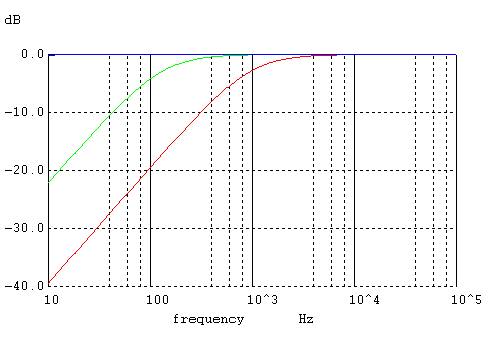
When the piezo pickup is wired through a typical line input, it creates a high-pass filter of 200 Hz (Green Line), which eliminates the bass. If you wire it into a typical mic input, the impedance is around 7 kilohm and this mismatch causes an even greater high-pass at 1000 Hz (Red Line), which is shown in the graph below:
Here is the graph

This would be a problem, but I usually high-pass my reverbs to either 350 or 600 Hz anyways. Those low to mid low frequencies muddy up the sound of a reverb and I end up cutting them anyways. I don’t really see this to be a big problem for me right now with this project. I would love to have that information available, and I found some solutions that I can try in the future.

One of those solutions is to create a FET amplifier which matches the electrical issue involved with piezo mics. There is also a higher quality, lower noise version. These seem easy enough to create, though I don’t know much about them because my knowledge in creating electrical devices is almost null. I will have to do a little research in the future to have the ability to create these for my contact mics.

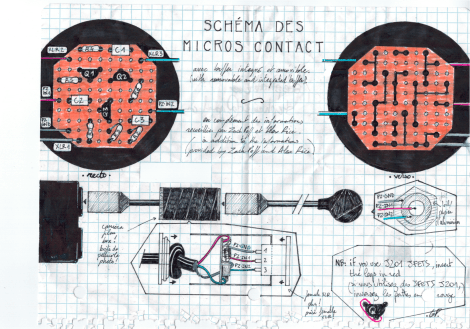
Another solution is to build a piezo pre-amp created by Alex Rice. He created a phantom powered preamp which the end result is a balanced output for a piezo mic. Zach Poff recreated all of these designs once Alex’s project went off the web. This seems to be a much more doable project for me because all the schematics are there and ready to be put onto a PCB board for production, as seen below.
PCB Design

There is also a great picture showing how to create this same pre-amp on regular perfboard! This is amazing for me because I can just buy this and create a working version very easily, with little electronics knowledge needed.
Perfboard

Here is the end result if you follow everything. I think it is a doable improvement after this version of my plate reverb, or if the result of just wiring the mic into a 1/4″ line input doesn’t work out like I want it to, I can try and put it together at the end of my build.
End Result
One last solution I found was to take two piezo mics and sandwich them together. Then you would take the “hot” wire from each of them and run them to an XLR’s hot and cold pins. Then you would combine the ground cables from both and run them into the ground of the XLR. This is an interesting way to create a balanced output from the piezo’s but I have one major issue with it. Would it be an omni directional polar pattern because both of the mics are wired into the XLR? Or would it somehow be directional, here is a picture of his end result:
Sandwichpiezo
He states that making them directional is a further study and I might contact him to see he if has progressed in it at all. The only way would be to build one and test it, which could possibly be done with this reverb since the piezo mics are fairly cheap. The output on the website sounded pretty well, and this would be the easiest solution to the problem of balancing a piezo mic.

I did find at the end of my research a very easy way to make a contact mic useable with an XLR output, which I will end up trying also in my plate reverb!