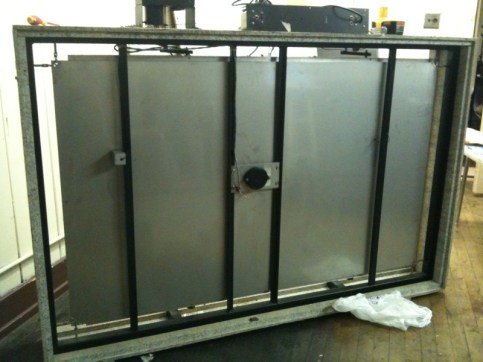
Plate Reverb Build: Steel Choices

For plate reverbs, there are pretty much two different kinds of steel that you can use for your plate. The first would be cold-rolled, which is what EMT used in the past to make their 140’s. Those are known as one of the best physical plate reverb’s to this day. It is hard to find information on why they used cold-rolled steel for their reverbs. Bob Buontempo has heard from others that cold-rolled has a more natural sound to it as well as a less metallic decay.

Jim Cunningham of JCC and Associates used the other option, stainless steel. In this article, he says that during his research, he found that stainless steel had a better high frequency response than cold-rolled. This is more suited for rock music. He also said the cold-rolled is more like a concert hall, which suits classical music. Bob has also heard people using stainless because it is more consistent, as well as it being tarnish proof.

It is a very subjective subject on what you should use since both options have worked in the past. Because of this, I will have to make a reverb with both cold-rolled and stainless to hear the differences for myself and come to a conclusion.


Plate Reverb Build: Damping Plate Research

With plate reverbs, a damping plate will effect the overall time of the reverb. The ones that EMT used could vary the reverb time from 2-5 seconds long. There are also several different ways to add one of these to a plate reverb. On the Ecoplate blueprints, they state that you should use Shasta ceiling tile (or any Owns Corning pinperf) cut into a lightweight steel frame. There are other reverbs that use regular fiberglass mounted to a plywood board, but according to Crossen Streams, who restored an ecoplate, doing that does not properly absorb the sound. I am guessing this is because it is fairly thin and the sound would go through it and come back without fully absorbing the sound.

Here are two pictures of the back of an old damping plate (Left) and a restored Ecoplate damping plate from Crossen Streams (Right):

fiber new

I have also seen DIY projects with fiberglass inside a wider frame and not mounted to anything. I am not sure on the effects of that and I might have to try it when it comes to the damping pate of my project.

A damping plate seems pretty simple to put on my reverb. The only thing I would have to figure out is how to make it adjustable so I can use it for my needs. I will probably figure something out after this project for my class is done. My overall plan would be to have a motor for it so it can be adjusted very easily. Idealy what the Pluto plate reverb does with an application controlling the damper is what I would want to do if I make these for commercial use.

Plate Reverb Build: Critiquing another D.I.Y Project, Part 2

For this critique, I will be looking at JCC & Associates’ Ecoplate Plate Reverb.

ecoplate

There are a lot of great things about this plate reverb. One of the ones that I liked the most was the fact that it is a close take on the legendary EMT140. One of the more intriguing parts of this is the fact that you can’t flat out buy one from their website or anywhere else. They only give you their schematics on their website, along with some of the parts that you can buy off of them.

And that comes to some of the things that I don’t like about it. There aren’t any instructions on how to put this one together. You are sort of on your own, though they have the most detailed schematics that I have found so far. Also, if you don’t know anything really about electronics and how to read and put together schematics, then you are at a major disadvantage on how to make their power amp and pre-amp.

This is what I eventually want to turn my reverb into after a few prototype versions, which will scale up to the quality that the Ecoplate brings to the table. I never heard of this plate reverb before this project, so I’m not really sure on the overall draw of this particular reverb, though people seem to really like this one as well.

Pros:

  • Similar to the iconic EMT 140
  • Very detailed blueprint
  • Can buy the same voice coil and mics they use from them

Cons:

  • No actual pictures of unit on website
  • No directions on how to build them