Plate Reverb Build: Schedule

Now I am at a point in this project where all I have left to do is to build the reverb itself. I have done almost all the research, which I will be finishing up this week. I am treating week 9 as a flex week. If there are any difficulties that come up before that, there is a week where I can make it up.  I am still not sure if I will be making a damping plate and wooden frame for this reverb or if I will wait until later in the summer to do so.

Here is my whole build schedule for the rest of this project.

This week (6):

  • Build Steel Frame
  • Research Electronics, Part 2
  • Research Steel Acoustics

Week 7 (5/17-5/23):

  • Hang Plate By Frame
  • Build and wire all Electronics

Week 8 (5/24-5/30):

  • Mount Piezo Mics
  • Mount Transducer
  • Test Reverb to see if it works

Week 9 (5/31-6/6):

  • Analyze results of test
  • Damping Plate ???
  • Wooden Frame ???

Week 10 (6/7-6/13):

  • Tweak final product
  • Make samples to put on website
  • Take professional pictures

Plate Reverb Build: Damping Plate Research

With plate reverbs, a damping plate will effect the overall time of the reverb. The ones that EMT used could vary the reverb time from 2-5 seconds long. There are also several different ways to add one of these to a plate reverb. On the Ecoplate blueprints, they state that you should use Shasta ceiling tile (or any Owns Corning pinperf) cut into a lightweight steel frame. There are other reverbs that use regular fiberglass mounted to a plywood board, but according to Crossen Streams, who restored an ecoplate, doing that does not properly absorb the sound. I am guessing this is because it is fairly thin and the sound would go through it and come back without fully absorbing the sound.

Here are two pictures of the back of an old damping plate (Left) and a restored Ecoplate damping plate from Crossen Streams (Right):

fiber new

I have also seen DIY projects with fiberglass inside a wider frame and not mounted to anything. I am not sure on the effects of that and I might have to try it when it comes to the damping pate of my project.

A damping plate seems pretty simple to put on my reverb. The only thing I would have to figure out is how to make it adjustable so I can use it for my needs. I will probably figure something out after this project for my class is done. My overall plan would be to have a motor for it so it can be adjusted very easily. Idealy what the Pluto plate reverb does with an application controlling the damper is what I would want to do if I make these for commercial use.

Plate Reverb Build: Needed Materials

Building this plate reverb will not be without some costs. I have come up with everything that will be needed to complete this project.

1x Cold Rolled Steel Plate – ($26)
2x 1-1/2 in. x 60 in. Zinc-Plated Slotted Angle ($28)
2x 1-1/2 in. x 14-Gauge x 36 in. Zinc-Plated Slotted Angle ($52)
1x 12-pack 20mm Piezoelectric Elements/Contact Pickups with 2″ Leads ($17)
1x Vidsonix Ghost Transducer ($20)
1x GLS Audio 1/4″ Jacks Female TS Mono Panel Mount Jack – 4 PACK ($12)
8x 880 lb. x 1/4 in. Zinc-Plated Quick Link ($18)
8x 1/4 in. x 2 in. Zinc-Plated Steel Eye Bolts with Nut ($5)
1x TEKTON 6555 Rivet Gun with 40-pc. Rivets ($14)
1x Neiko Hand Held Power Punch, Sheet Metal Hole Punch Kit($31)
16x Stanley-National Hardware 1-in Metallic Corner Brace ($25)

Overall, the entire cost of this project will be $248 if I don’t include the wooden frame and damping plate, which are both optional at this point. This doesn’t include the extra nuts, bolts and screws that I will need to keep everything together. It also leaves me with some extra supplies for my second attempt at it, and I won’t have to buy the tools again.

Next up is buying all of these materials, as well as researching the acoustics of metals and damping plates, which will come later this weekend.

Plate Reverb Build: The Blueprint

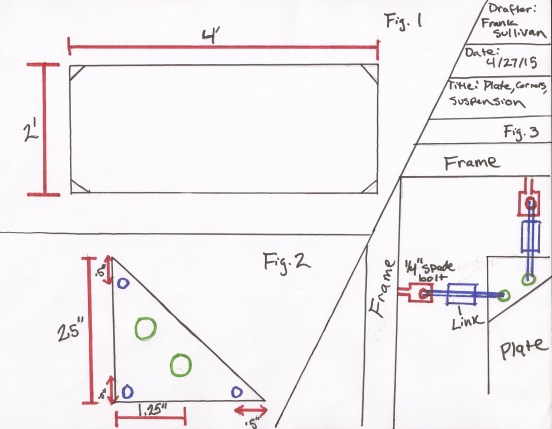
Over the few days, I have been putting together a blueprint of what I eventually want my plate reverb to look like. Here are the first sketches:

figure1-3
My plate reverb’s steel sheet will be 2’x4′ and will have metal triangles installed on each of the corners for reinforcement. (Figure 1). The corners will be 2.5 inches tall and wide with three small holes for the rivets (Figure 2), which will combine the two sheets of steel. There will also be two 1/4″ holes to suspend the plate from the frame. The frame and plate will be joined by either Eye or Spade Bolts connected to the frame. There will be two 1/4″ quick links on each corner too (Figure 3).


PLateFront
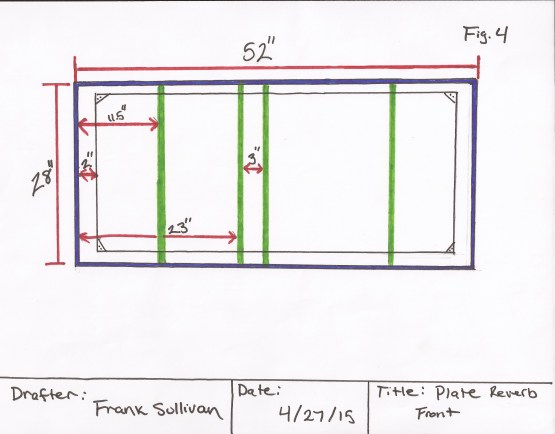
The frame will be constructed with Zinc-Plated Slotted Angle (Blue) which will be 2″ longer than the sheet metal on each side to come to a length of 28″x52″ (Figure 4). There will also be Four sections of the slotted angle which will be for support and running cables up them (Green). Two of these will be 23″ from each end with a 3″ gap between them to mount the Transducer. There will be two more sections 11.5″ from each end to mount the contact mics and run the cables from. There will also be two 6″ sections on the bottom to use as feet.


plateback
On the backside of the unit will be 1″x1″ metal corner braces to hold the reverb in place. (Red) There will be two of these located in each corner. I will also drill three 1/8″ holes to adhere the transducer to the plate (Orange).