Plate Reverb Build: Hang Plate from Frame

Now that I have my frame complete, it is time to hang the plate by the frame. The way that I did this is by strengthening the corners with a sheet of aluminum. I cut out the corners off the sheet (pretty badly) with a grinder and started to use my sheet metal puncher to make two 9/32″ holes and three 1/8″ holes for the rivets. I also put three 1/8″ holes in my plate to adhere the triangles to the plate.

plate1         plate2

After making all the rivet holes, I started riveting the corners to the plate, and when I was complete with this, I punched through the plate to create the 9/32″ holes to hang by the links.
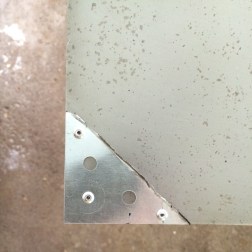
plate3plate4

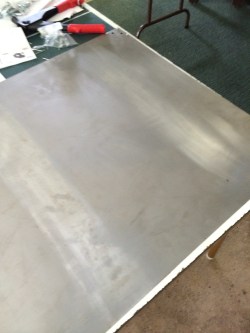
Here is a completed look at my plate after the rivets were put in.

plate5

After the rivets were put in, I turned it over to see how the other side of the plate looked. On the side you saw before, I had to sand off the rust because I am using cold-rolled steel, which rusts when oxygen comes in contact with it. This side needed to be sanded down too because there was rust. Here are some before and after pictures of my sanding the plate.
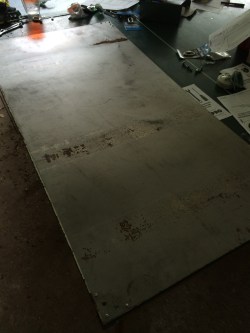
plate6       plate7

plate8       plate9

plate10       plate11

After I sanded down my plate, I brought it over to the frame and set it on it to see how it would look and where I needed my links and eye bolts to be.
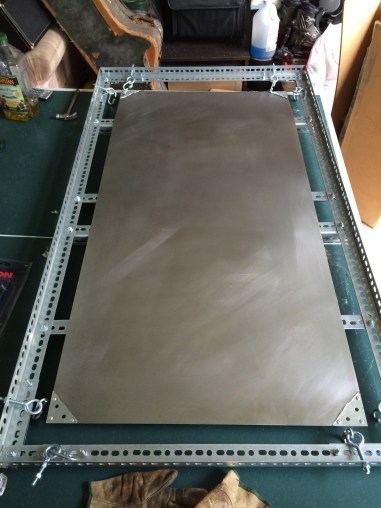
plate11

After putting the eye bolts and links where I wanted them, I started connecting the links to the frame and tightening them to tension the frame a little bit, here is a close up of that as well as a video describing what I just did.
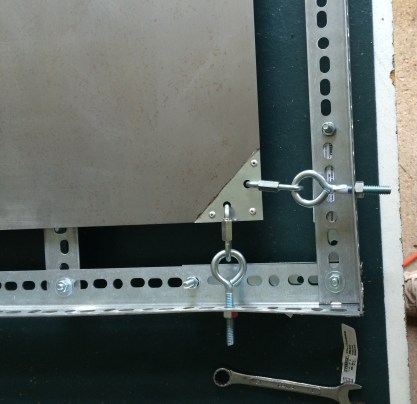
plate12

After hanging the plate and tensioning it so it is off the frame, I went and did an initial tuning of my plate. The way you do this is exactly the same as a drum and I demonstrate that in this video.

Since tuning the plate tight made my entire frame less rigid and cockeyed, I will probably just leave it flat so it can keep the structure how I wanted it. I also added some oil to my plate so that the rust does not return as fast. Here is a video demonstrating that.

Up next, I will mount my transducer and piezo mics to the frame as well as wire everything up and test the reverb to make sure it works.

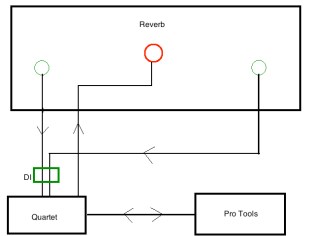
Plate Reverb Build: Steel Choices

For plate reverbs, there are pretty much two different kinds of steel that you can use for your plate. The first would be cold-rolled, which is what EMT used in the past to make their 140’s. Those are known as one of the best physical plate reverb’s to this day. It is hard to find information on why they used cold-rolled steel for their reverbs. Bob Buontempo has heard from others that cold-rolled has a more natural sound to it as well as a less metallic decay.

Jim Cunningham of JCC and Associates used the other option, stainless steel. In this article, he says that during his research, he found that stainless steel had a better high frequency response than cold-rolled. This is more suited for rock music. He also said the cold-rolled is more like a concert hall, which suits classical music. Bob has also heard people using stainless because it is more consistent, as well as it being tarnish proof.

It is a very subjective subject on what you should use since both options have worked in the past. Because of this, I will have to make a reverb with both cold-rolled and stainless to hear the differences for myself and come to a conclusion.


Plate Reverb Build: Researching Electronics, Part 2

On my last post: Researching the Electronics, Part 1. I talked about the piezo mics and what I would need to do to get them to have a balanced output. For this research, I will be talking about the transducer that I am using, as well as my input/output scenario.

ghost

For my transducer, I have decided on the Vidsonix Ghost Transducer. In my researching and looking at other DIY projects, including this Tape Op thread on them, I have found this to be what other people have started to use and are great for the money. I also have a couple of old speakers that I can dismantle and try out those voice coils to see how they sound, which will probably happen in future iterations of my plate reverbs.

My input/output will be all 1/4″ TS in and out. My recorded tracks will output from my Apogee Quartet into the 1/4″ TS input to the Vidsonix Ghost. Then, it will be picked up through my Piezo discs back through a 1/4 TS connector. I will have DI boxes to convert into a balanced mic level input, which will go back to the inputs of my Apogee Quartet’s pre-amps and into Pro Tools. I have decided on the 1/4″ TS because my piezo mics are unbalanced, so TRS connectors would be unnecessary.

Here is a diagram of that setup:

IO


Overall, I think this combination will be a good starting point for these reverbs and I can always upgrade my components at a later date.

Plate Reverb Build: Damping Plate Research

With plate reverbs, a damping plate will effect the overall time of the reverb. The ones that EMT used could vary the reverb time from 2-5 seconds long. There are also several different ways to add one of these to a plate reverb. On the Ecoplate blueprints, they state that you should use Shasta ceiling tile (or any Owns Corning pinperf) cut into a lightweight steel frame. There are other reverbs that use regular fiberglass mounted to a plywood board, but according to Crossen Streams, who restored an ecoplate, doing that does not properly absorb the sound. I am guessing this is because it is fairly thin and the sound would go through it and come back without fully absorbing the sound.

Here are two pictures of the back of an old damping plate (Left) and a restored Ecoplate damping plate from Crossen Streams (Right):

fiber new

I have also seen DIY projects with fiberglass inside a wider frame and not mounted to anything. I am not sure on the effects of that and I might have to try it when it comes to the damping pate of my project.

A damping plate seems pretty simple to put on my reverb. The only thing I would have to figure out is how to make it adjustable so I can use it for my needs. I will probably figure something out after this project for my class is done. My overall plan would be to have a motor for it so it can be adjusted very easily. Idealy what the Pluto plate reverb does with an application controlling the damper is what I would want to do if I make these for commercial use.

Plate Reverb Build: Needed Materials

Building this plate reverb will not be without some costs. I have come up with everything that will be needed to complete this project.

1x Cold Rolled Steel Plate – ($26)
2x 1-1/2 in. x 60 in. Zinc-Plated Slotted Angle ($28)
2x 1-1/2 in. x 14-Gauge x 36 in. Zinc-Plated Slotted Angle ($52)
1x 12-pack 20mm Piezoelectric Elements/Contact Pickups with 2″ Leads ($17)
1x Vidsonix Ghost Transducer ($20)
1x GLS Audio 1/4″ Jacks Female TS Mono Panel Mount Jack – 4 PACK ($12)
8x 880 lb. x 1/4 in. Zinc-Plated Quick Link ($18)
8x 1/4 in. x 2 in. Zinc-Plated Steel Eye Bolts with Nut ($5)
1x TEKTON 6555 Rivet Gun with 40-pc. Rivets ($14)
1x Neiko Hand Held Power Punch, Sheet Metal Hole Punch Kit($31)
16x Stanley-National Hardware 1-in Metallic Corner Brace ($25)

Overall, the entire cost of this project will be $248 if I don’t include the wooden frame and damping plate, which are both optional at this point. This doesn’t include the extra nuts, bolts and screws that I will need to keep everything together. It also leaves me with some extra supplies for my second attempt at it, and I won’t have to buy the tools again.

Next up is buying all of these materials, as well as researching the acoustics of metals and damping plates, which will come later this weekend.

Plate Reverb Build: Researching the electronics, Part 1

Aside from actually building the plate, the most crucial part of of this project is the electronics involved.  Today I will talk about the contact mics that I will use for this plate reverb.

Now, the contact mics that I will use for this are Piezo pickups from amazon. These are great for my purpose in creating a working plate reverb because they are inexpensive and effective at the same time. However, there is one problem with these. They are unbalanced and do not match well with the inputs from most audio components.  This is because the impedances don’t match. This article states that using a typical line input is 50 kilohm. A contact mic like the one I am using needs a much higher impedance, around 1 megaohm.

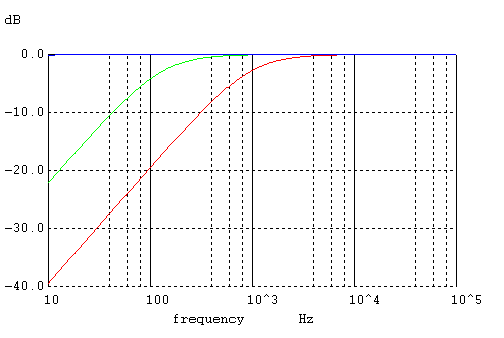
When the piezo pickup is wired through a typical line input, it creates a high-pass filter of 200 Hz (Green Line), which eliminates the bass. If you wire it into a typical mic input, the impedance is around 7 kilohm and this mismatch causes an even greater high-pass at 1000 Hz (Red Line), which is shown in the graph below:
Here is the graph

This would be a problem, but I usually high-pass my reverbs to either 350 or 600 Hz anyways. Those low to mid low frequencies muddy up the sound of a reverb and I end up cutting them anyways. I don’t really see this to be a big problem for me right now with this project. I would love to have that information available, and I found some solutions that I can try in the future.

One of those solutions is to create a FET amplifier which matches the electrical issue involved with piezo mics. There is also a higher quality, lower noise version. These seem easy enough to create, though I don’t know much about them because my knowledge in creating electrical devices is almost null. I will have to do a little research in the future to have the ability to create these for my contact mics.

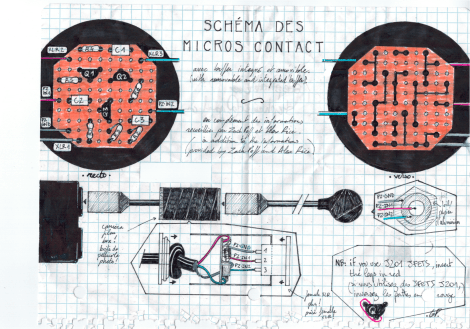
Another solution is to build a piezo pre-amp created by Alex Rice. He created a phantom powered preamp which the end result is a balanced output for a piezo mic. Zach Poff recreated all of these designs once Alex’s project went off the web. This seems to be a much more doable project for me because all the schematics are there and ready to be put onto a PCB board for production, as seen below.
PCB Design

There is also a great picture showing how to create this same pre-amp on regular perfboard! This is amazing for me because I can just buy this and create a working version very easily, with little electronics knowledge needed.
Perfboard

Here is the end result if you follow everything. I think it is a doable improvement after this version of my plate reverb, or if the result of just wiring the mic into a 1/4″ line input doesn’t work out like I want it to, I can try and put it together at the end of my build.
End Result
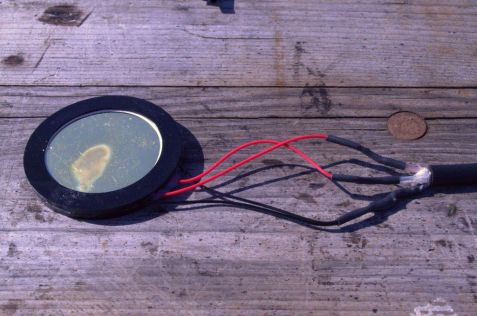
One last solution I found was to take two piezo mics and sandwich them together. Then you would take the “hot” wire from each of them and run them to an XLR’s hot and cold pins. Then you would combine the ground cables from both and run them into the ground of the XLR. This is an interesting way to create a balanced output from the piezo’s but I have one major issue with it. Would it be an omni directional polar pattern because both of the mics are wired into the XLR? Or would it somehow be directional, here is a picture of his end result:
Sandwichpiezo
He states that making them directional is a further study and I might contact him to see he if has progressed in it at all. The only way would be to build one and test it, which could possibly be done with this reverb since the piezo mics are fairly cheap. The output on the website sounded pretty well, and this would be the easiest solution to the problem of balancing a piezo mic.

I did find at the end of my research a very easy way to make a contact mic useable with an XLR output, which I will end up trying also in my plate reverb!