Plate Reverb Build: Steel Choices

For plate reverbs, there are pretty much two different kinds of steel that you can use for your plate. The first would be cold-rolled, which is what EMT used in the past to make their 140’s. Those are known as one of the best physical plate reverb’s to this day. It is hard to find information on why they used cold-rolled steel for their reverbs. Bob Buontempo has heard from others that cold-rolled has a more natural sound to it as well as a less metallic decay.

Jim Cunningham of JCC and Associates used the other option, stainless steel. In this article, he says that during his research, he found that stainless steel had a better high frequency response than cold-rolled. This is more suited for rock music. He also said the cold-rolled is more like a concert hall, which suits classical music. Bob has also heard people using stainless because it is more consistent, as well as it being tarnish proof.

It is a very subjective subject on what you should use since both options have worked in the past. Because of this, I will have to make a reverb with both cold-rolled and stainless to hear the differences for myself and come to a conclusion.

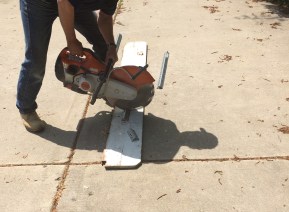
 

Plate Reverb Build: Frame Construction

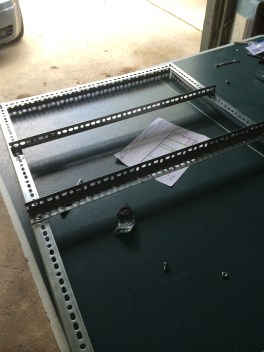
This week, I constructed the entire frame together for my plate reverb. From my needed materials post, you can see that I needed two pieces of 1 1/2″ x 60″ Zinc Plated Slotted Angle and six pieces of 1 1/2″ x 36″ Zinc Plated Slotted Angle to build the entire frame. After picking these up, they needed to be cut to the size that I designed in my blueprint.

However, after inspection of all my parts, I underestimated the length that my eye hooks and links would take up, so I extended my frame by one inch on all sides.

framebuild1 framebuild2

After cutting them to size, I needed to file down the edges that were just cut.

framebuild3

After getting these filed down the best that they could, I started by bolting down the corners through the slots that matched up to create my outside frame.

framebuild4

After getting this complete, I began to make the frame more rigid by adding four joints on the “outside” of the frame (the plate will go on the opposite end).

framebuild5 framebuild6

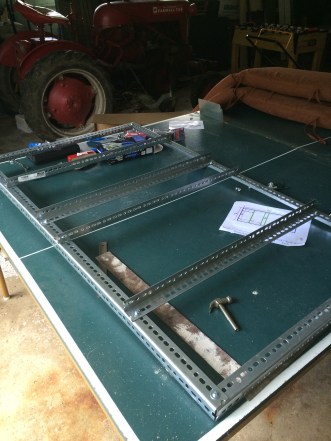
Here is the frame with the joint support:

framebuld7

After putting everything together, we brought out a square to make sure that all the corners were exactly square. After doing this, we tightened everything down and added support for the corners to make them more stable.

framebuild8 framebuild9

Here is the completed frame:

framebuild10

If the corner supports don’t work as well, I can always take them off and go back to the metal triangles to add rigidness to this frame. Next up, I will be installing the plate to this frame, which you should see done this coming week.

Plate Reverb Build: Schedule

Now I am at a point in this project where all I have left to do is to build the reverb itself. I have done almost all the research, which I will be finishing up this week. I am treating week 9 as a flex week. If there are any difficulties that come up before that, there is a week where I can make it up.  I am still not sure if I will be making a damping plate and wooden frame for this reverb or if I will wait until later in the summer to do so.

Here is my whole build schedule for the rest of this project.

This week (6):

  • Build Steel Frame
  • Research Electronics, Part 2
  • Research Steel Acoustics

Week 7 (5/17-5/23):

  • Hang Plate By Frame
  • Build and wire all Electronics

Week 8 (5/24-5/30):

  • Mount Piezo Mics
  • Mount Transducer
  • Test Reverb to see if it works

Week 9 (5/31-6/6):

  • Analyze results of test
  • Damping Plate ???
  • Wooden Frame ???

Week 10 (6/7-6/13):

  • Tweak final product
  • Make samples to put on website
  • Take professional pictures

Plate Reverb Build: Needed Materials

Building this plate reverb will not be without some costs. I have come up with everything that will be needed to complete this project.

1x Cold Rolled Steel Plate – ($26)
2x 1-1/2 in. x 60 in. Zinc-Plated Slotted Angle ($28)
2x 1-1/2 in. x 14-Gauge x 36 in. Zinc-Plated Slotted Angle ($52)
1x 12-pack 20mm Piezoelectric Elements/Contact Pickups with 2″ Leads ($17)
1x Vidsonix Ghost Transducer ($20)
1x GLS Audio 1/4″ Jacks Female TS Mono Panel Mount Jack – 4 PACK ($12)
8x 880 lb. x 1/4 in. Zinc-Plated Quick Link ($18)
8x 1/4 in. x 2 in. Zinc-Plated Steel Eye Bolts with Nut ($5)
1x TEKTON 6555 Rivet Gun with 40-pc. Rivets ($14)
1x Neiko Hand Held Power Punch, Sheet Metal Hole Punch Kit($31)
16x Stanley-National Hardware 1-in Metallic Corner Brace ($25)

Overall, the entire cost of this project will be $248 if I don’t include the wooden frame and damping plate, which are both optional at this point. This doesn’t include the extra nuts, bolts and screws that I will need to keep everything together. It also leaves me with some extra supplies for my second attempt at it, and I won’t have to buy the tools again.

Next up is buying all of these materials, as well as researching the acoustics of metals and damping plates, which will come later this weekend.